Managed AI Privacy: Why Private Deployment Beats a Ban
2026-10-14

Managed AI deployments do introduce new privacy risks, but they are not a reason to avoid managed AI; they are a reason to choose infrastructure and controls deliberately. The three priorities that matter most are limiting what data ever reaches a model, keeping exportable logs with real retention control, and demanding contractual transparency from any vendor touching your data. Everything else, from taxonomy to regulation, builds on getting these three right.
***
> TL;DR:
>
> - An analysis of 321 AI privacy incidents found that most involved risks created or worsened by AI, while differential privacy and federated learning only reduce exposure.
> - Free or personal accounts can carry broader data use terms than business plans, so require business tier access for every work related AI task.
> - Because litigation can require records to be preserved, organizations should test log export before use and confirm retention controls with vendors.
> - Review each messaging integration separately because connecting Telegram, Discord, Slack, or WhatsApp creates new data paths that may not inherit core deployment protections.
***
Table of Contents
- What privacy risks does managed AI actually introduce?
- How do foundation models change the privacy equation?
- What regulatory and standards signals should organizations track?
- Which safeguards actually reduce managed AI privacy risk?
- How does a managed, private deployment put these safeguards into practice?
- Why risk-managed adoption beats both blanket bans and blind trust
- Deploying a privacy-minded managed AI assistant with ClawBase
- FAQ
- Sources
What privacy risks does managed AI actually introduce?
We like to start with the taxonomy because vague fear is useless and specific risk is actionable. A detailed analysis of 321 documented AI privacy incidents found that in the large majority of cases, the AI technology either created a new type of privacy risk or made an existing one worse. That is not a reason for alarm so much as a map of where to look first.
The recurring failure modes we see across managed and self-hosted deployments alike:
- Training-data leakage and memorization: models can reproduce fragments of their training data verbatim, including personal details that were never meant to resurface.
- Undeclared secondary uses: inputs submitted for one task get repurposed for model improvement or monetization without clear user knowledge.
- Re-identification from low-quality anonymization: stripped datasets can often be reconstructed by cross-referencing with other available information.
- Profiling and biased classification: inference engines build behavioral or even physiognomic profiles from patterns the user never explicitly shared.
- Generative dissemination harms: deepfakes and synthetic media built from leaked or scraped personal content create reputational damage that is hard to reverse.
- Session persistence risk: conversation history held only in a vendor's cloud can become a liability if it is incomplete, unexportable, or quietly altered.
None of these risks are unique to any single vendor. They are structural, which is why the fix has to be structural too: data minimization at the input layer, architecture choices that limit exposure, and contracts that make vendor behavior auditable rather than assumed.
How do foundation models change the privacy equation?
Traditional software had a fairly contained attack surface: a database, an API, a few access points. Foundation models break that containment. Stanford HAI's research on data privacy describes privacy risk as something that now runs across the entire model lifecycle, from the mass scraping used to build training sets, through fine-tuning, all the way to the outputs a model generates months or years later.
A few mechanisms explain why this lifecycle view matters:
- Mass-data scraping pulls in far more personal information than any single data processing agreement anticipated, often without consent trails.
- Model inversion and extraction attacks let an adversary query a model repeatedly to reconstruct pieces of its training data.
- Prompt injection manipulates an AI agent into leaking context it was never supposed to reveal, including prior session content.
- Data poisoning corrupts training inputs so the model later behaves in ways the operator never intended, including leaking planted data.
- Agent-level persistence links data across sessions, turning what used to be a stateless query into a standing profile of the user.
A large majority of the AI privacy incidents reviewed in the taxonomy study involved a new or amplified risk category, not a risk that existing privacy law already anticipated. That gap is exactly why differential privacy and federated learning, while genuinely useful, are partial mitigations rather than complete fixes: they reduce exposure at the margins but do not eliminate memorization, inference, or the consequences of agent persistence once a model is deployed and used daily.
What regulatory and standards signals should organizations track?
Regulatory movement on AI privacy is accelerating, and three signals stand out as the most concrete right now.
The FTC's inquiry into AI companions directed compulsory process to study how companies offering AI companions collect, share, and monetize user inputs. That inquiry, paired with the FTC's broader Generative AI 6(b) resolution, signals that regulators expect companies to document exactly how user data moves through a model pipeline, not just promise that it is handled responsibly.
On the standards side, NIST's Cyber AI Profile gives organizations an actionable way to fold AI-specific risk into existing cybersecurity programs rather than building a separate AI silo. It maps directly onto:
- Securing AI components the same way you would secure any production system, including access boundaries and patch cadence.
- Model governance, meaning documented ownership of what each model is allowed to do and see.
- Logging aligned with the Cybersecurity Framework, so AI activity is auditable the same way network activity already is.
For teams building out governance, a practical compliance checklist looks like this: run a privacy impact assessment before deploying any new model, collect vendor evidence of training-data provenance, confirm breach notification procedures cover AI-specific incidents, and revisit the assessment whenever a vendor changes its model lineup or data handling terms.
Which safeguards actually reduce managed AI privacy risk?
Once the risks and the regulatory backdrop are clear, the work becomes operational. Here is the sequence we recommend, roughly in order of impact:
- Define a data minimization policy. Decide explicitly what categories of data (health records, financial details, client PII) never get typed into any AI tool, managed or not.
- Filter and redact sensitive fields before submission. Deterministic tokenization lets you replace identifiers with stable placeholders so a model can still reason about structure without seeing raw data.
- Require business-tier accounts for every work task. Free or personal AI accounts routinely carry broader data-use terms than business plans, and enforcing business-tier access is one of the simplest, highest-leverage controls available.
- Choose encrypted, dedicated infrastructure over shared multi-tenant environments. Encryption in transit and at rest should be non-negotiable, not an add-on.
- Demand exportable logs and real retention control. Under Federal Rule of Civil Procedure 37, organizations have preservation obligations in litigation, and an AI agent whose session history lives only in a vendor's cloud creates a spoliation trap if that history can't be exported on demand.
- Run vendor due diligence before signing anything. Ask for training-data commitments, update cadence, data provenance documentation, and SLAs in writing.
- Schedule privacy impact assessments and continuous monitoring. A one-time review goes stale the moment a vendor updates its model lineup.
Before shipping any integration that touches a code repository, it also helps to validate changes with a dedicated review layer; tools like Veridical's AI code review for GitHub catch security regressions in pull requests before they reach production, which matters when an AI-assisted workflow is writing or modifying code that touches sensitive data paths.
Pro Tip: *Test your vendor's data export process before you need it in a legal dispute, not during one.*
How does a managed, private deployment put these safeguards into practice?

Everything above points toward one architectural conclusion: the safest way to run an AI agent at work is on infrastructure built around isolation and exportability from the start. That is the model we built when we designed managed hosting for OpenClaw.
Every deployment runs on a dedicated, encrypted server, never shared tenancy, with daily encrypted backups and persistent memory that stays under the account holder's control rather than scattered across a vendor's shared training pipeline.
For teams onboarding a managed assistant, the practical checklist looks like this:
- Confirm the account tier is business-grade, not a personal or free plan.
- Test the log export workflow immediately after setup, before real data flows through it.
- Set role-based access so only the people who need agent access have it.
- Review the architecture and privacy design choices behind the deployment before connecting any sensitive workflow.
- Confirm permission-aware file access controls are active before granting the agent file system access.
Integration with Telegram, Discord, Slack, or WhatsApp adds convenience, but each connection is a new data path worth reviewing individually rather than assuming it inherits the same protections as the core deployment.
Why risk-managed adoption beats both blanket bans and blind trust

We think the real failure mode in most organizations is not reckless AI adoption, it is the binary choice between banning AI outright or adopting it with no governance at all. Neither protects anyone. Risk-managed adoption, where every integration has a documented data flow and every vendor claim has supporting evidence, lets teams capture the real productivity gains without betting the organization on a vendor's goodwill.
The way to know it's working is boring and that's the point: regular privacy impact assessments, documented vendor commitments you can produce on request, and board-level visibility into which models touch which data. Progress should be auditable, not aspirational.
> *— Iosif Peterfi*
Deploying a privacy-minded managed AI assistant with ClawBase
If the controls in this article sound like a lot to build from scratch, that is exactly the gap managed hosting is meant to close. We provide managed hosting for OpenClaw that includes encrypted servers with persistent memory, daily backups, and simplified deployment, so the privacy architecture is already in place before your team sends a single message.
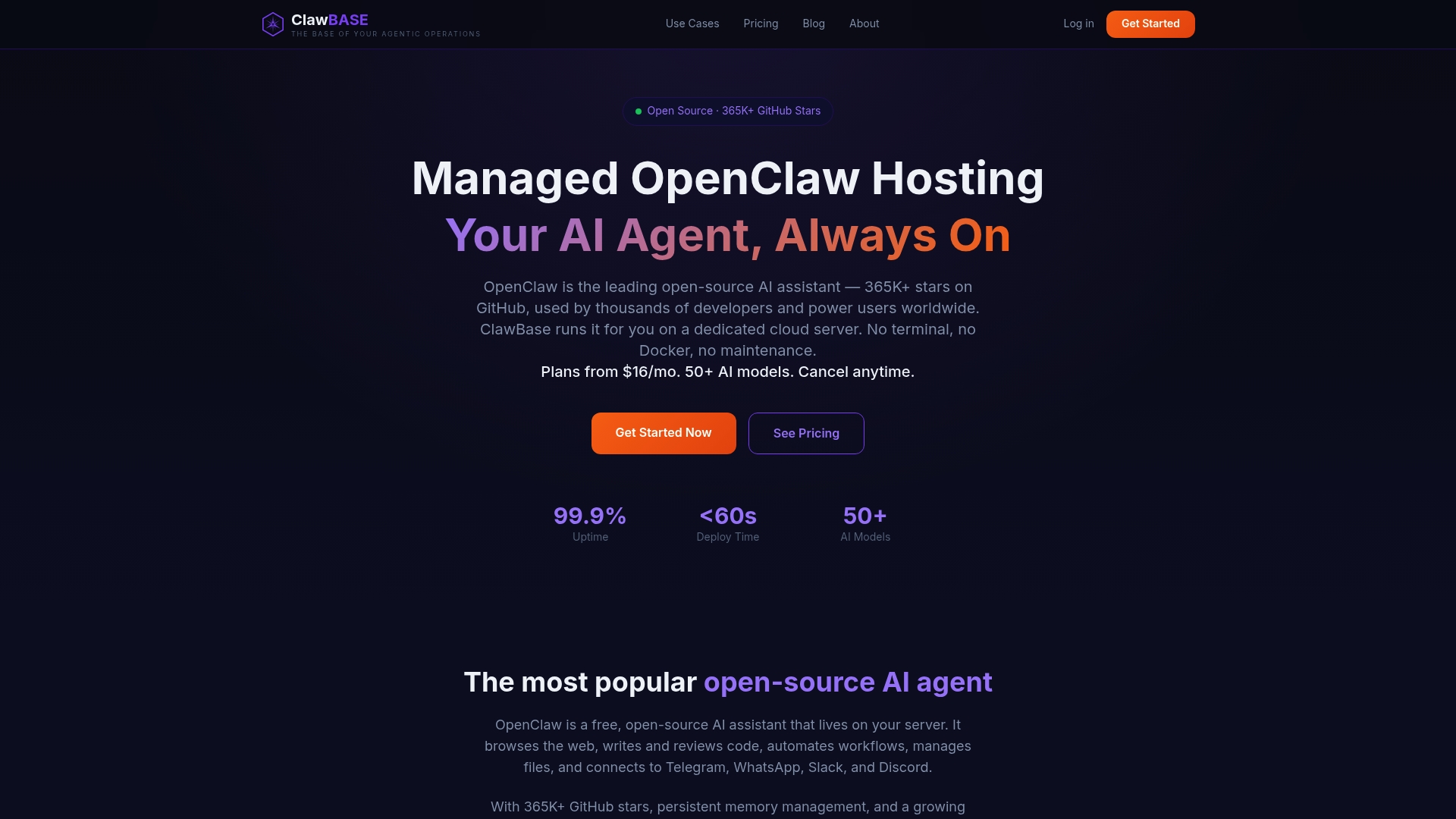
This setup fits developers who want agent capability without managing their own server, and it fits professional teams who need an auditable, private alternative to routing sensitive work through consumer-grade chat accounts. Plans start at LITE for $16 per month, with PRO and MAX tiers available for teams needing more model access and capacity, all on Clawbase. If you want to see what a managed deployment looks like in practice first, our pricing and plan details lay out exactly what each tier includes before you commit.
FAQ
What are the privacy concerns associated with artificial intelligence?
The core concerns are training-data leakage, undeclared secondary use of inputs, re-identification from weak anonymization, biased profiling, and deepfake-driven reputational harm. Research analyzing AI privacy incidents found that the large majority involved a new or worsened risk category, which is why standard data protection practices often need AI-specific updates.
What is the 30% rule for AI?
If you encountered a term in another context, it is worth confirming the source before applying it to privacy decisions.
Is artificial intelligence ethical?
Ethics in AI depends on how a system is built and governed, not on the technology itself: foundation models carry documented privacy risks across their lifecycle, as Stanford HAI's research outlines, and responsible use requires design-level privacy protections plus transparent vendor practices. Treating ethics as a governance question, backed by audits and documented commitments, is more useful than treating it as a yes-or-no label.
Which 3 jobs will not survive AI?
No credible source in this space makes a specific, verified claim about exactly which three jobs will disappear due to AI, and we are not going to invent one. Workforce impact varies heavily by task structure and industry, and any specific numbered prediction you see should be checked against its original source before you trust it.
How can organizations prepare for AI-related regulatory scrutiny?
Start with a privacy impact assessment for every AI deployment, then collect vendor documentation on training-data provenance and retention practices. Tracking signals like the FTC's inquiry into AI companions and NIST's Cyber AI Profile helps organizations align internal controls with where oversight is heading.
Sources
- Deepfakes, Phrenology, Surveillance, and More! A Taxonomy of AI Privacy Risks
- Data privacy and foundation models: Can we have both? | Stanford HAI
- FTC launches inquiry into AI chatbots acting as companions
- Cybersecurity Framework Profile for Artificial Intelligence (Cyber AI Profile) | NIST