Stop Token Theft: CVE Backed Telegram Bot Security for Developers
2026-09-05

Telegram bots are reasonably secure for production use when you treat the bot token like a root password, enforce TLS on webhooks, and audit every dependency before deployment. The platform itself is not the weak point. Leaked tokens, trojanized packages, and misconfigured plugins are. Rotate any exposed token immediately, verify your webhook's certificate chain, and run a dependency audit before you ship anything else.
***
> TL;DR:
>
> - Proper secret management includes storing tokens outside code, rotating them regularly, and revoking immediately upon suspicion of exposure.
> - Bots only access unencrypted messages, group messages when authorized, and callback data, but are excluded from secret chats, emphasizing limited data visibility.
> - Attack vectors are common through leakages via logs, supply-chain trojanized packages, and unpatched plugins, which require constant dependency and software audits.
> - Rapid response within the first hour of compromise focuses on token revocation, credential rotation, host rebuild, and log review to minimize damage.
> - Managed hosting providers improve security by handling automatic updates, secure secret storage, TLS management, and routine patching, reducing operational risks.
***
Table of Contents
- Is Telegram Bot Security Solid by Default?
- Bot Tokens, the Bot API, and Where Authentication Breaks Down
- The Attack Vectors That Actually Compromise Telegram Bots
- Building Security Into Your Deployment Pipeline, Not Bolting It On
- Keeping Your Dependencies From Becoming Someone Else's Backdoor
- What to Do in the First Hour of a Suspected Compromise
- How Managed Hosting Cuts Down Operational Risk
- Locking Down Command Handling and User Input
- Stopping Abuse Before It Becomes a Denial-of-Service Problem
- Protecting Sensitive Data Your Bot Touches
- Scoping Bot Permissions Beyond the Token Itself
- Staying Current With Telegram's Bot API Security Changes
- When to Self-Host and When to Hand It Off
- Deploying a Telegram-Connected Agent Without the Operational Overhead
- Sources
Is Telegram Bot Security Solid by Default?
Telegram's infrastructure handles transport encryption for you, but the privacy model has hard boundaries developers routinely misunderstand. Your bot is not a participant in end-to-end encrypted conversations, and it never will be.
Here's what actually reaches your server:
- Regular chat messages sent directly to your bot, including text, media, and metadata like timestamps and user IDs.
- Group messages, but only when your bot is an admin or the user explicitly addresses it, unless Privacy Mode is disabled.
- Callback data from inline keyboards and any information the user submits through forms or commands.
What your bot cannot touch: Secret Chats. Telegram's official developer documentation confirms bots are structurally excluded from that end-to-end encrypted layer, so any promise of "fully encrypted messaging" through a standard bot integration is inaccurate. Privacy Mode in groups limits what your bot sees to commands and direct mentions, which reduces noise but also means you cannot passively log group conversations for context without disabling it.
For your privacy policy, be specific about what you store and for how long. If you don't need message history, don't retain it. Minimization beats disclosure every time a regulator or a security researcher comes asking.
Bot Tokens, the Bot API, and Where Authentication Breaks Down
Every Telegram bot authenticates with a single string issued by @BotFather when you create it. That token is not an API key in the casual sense. It's a bearer credential with full control over the bot's identity, and Nordic APIs put it plainly: whoever holds that string can control that bot, full stop. There's no secondary factor, no session expiry, no built-in scoping.
Here's the practical sequence for handling tokens and webhooks correctly:
- Generate and store the token outside your codebase. Never hardcode it in a script or commit it to a repository.
- Configure your webhook over HTTPS using TLS 1.2 or higher, on one of Telegram's supported ports: 443, 80, 88, or 8443.
- Match your certificate's CN or SAN to your domain exactly. Self-signed certificates work, but Telegram requires you to upload the public key manually.
- Firewall your webhook endpoint to Telegram's published IP ranges where your infrastructure allows it.
- Revoke immediately through @BotFather the moment you suspect exposure, then generate a replacement and redeploy.
Tokens leak most often through debug logs, crash reports, and accidentally public config files. If your logging pipeline writes request URLs verbatim, your token may be exposed in plaintext on a log server.
The Attack Vectors That Actually Compromise Telegram Bots
Token leakage isn't theoretical. CVE-2024-9627 documents a WordPress Telegram plugin, versions up to 1.3, that let unauthenticated attackers view bot tokens outright through a plugin misconfiguration. No exploit chain required, just a page request.
Supply-chain attacks are the vector developers underestimate most. BleepingComputer reported trojanized PyPI packages, including forks of the popular Pyrogram library, that ship clean at install time and activate a backdoor only when the bot process actually starts. That timing defeats most install-time security scans, which check package contents, not runtime behavior. A separate campaign built around a package called "pyronut" registered hidden message handlers that gave attackers arbitrary shell execution the moment the bot came online, according to CybersecurityNews.
Once attackers hold a valid token, the vector shifts from "getting in" to "staying invisible." Cofense found that threat actors increasingly abuse the Telegram Bot API itself as a command-and-control and exfiltration channel, because traffic destined for Telegram's own domains looks routine to most network defenses. That's the uncomfortable truth: a stolen bot token doesn't just expose your bot, it can hand attackers a covert channel that blends into legitimate traffic almost perfectly.
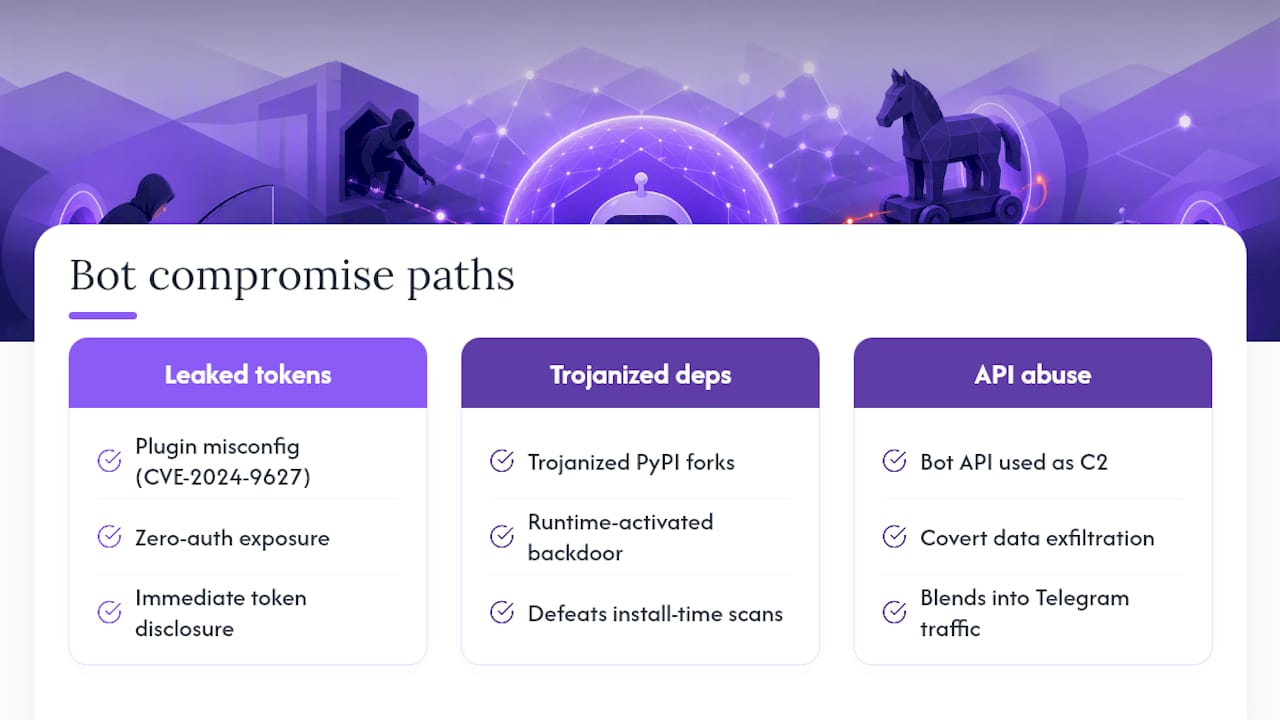
Statistic to hold onto: the WordPress plugin flaw required zero authentication to expose a working bot token, meaning exposure risk here had nothing to do with password strength and everything to do with unpatched software sitting on a live site.
Building Security Into Your Deployment Pipeline, Not Bolting It On
Treat secrets management as a pipeline problem, not a one-time setup step. Here's the priority order that actually holds up under audit:
- Store tokens in a vault or environment variable manager, not in source code or plaintext config files checked into version control.
- Rotate tokens on a schedule even without an incident, and always immediately after one.
- Strip secrets from logs and crash reports at the framework level. Configure your error-reporting tool, whether that's Sentry or a custom handler, to redact URL parameters and headers before they're written anywhere.
- Apply least privilege to every credential, including database connections and third-party API keys your bot touches, not just the Telegram token itself.
- Scan your CI/CD pipeline for secrets before every build. A leaked token in a build artifact is just as dangerous as one leaked in a public repo.
Pro Tip: *Set your crash-reporting tool to redact query parameters by default, not by exception. Most token leaks in production happen because a debug log captured a full request URL during an unrelated error, and nobody thought to scrub it until after the damage was done.*
Ephemeral credentials help too. If your infrastructure supports short-lived tokens for internal service-to-service calls, use them, and reserve the long-lived Telegram bot token for the one place it's actually required.
Keeping Your Dependencies From Becoming Someone Else's Backdoor
Pin exact package versions and commit your lockfile. That single habit closes most of the door on the runtime-activated backdoors described earlier, because it prevents an automatic upgrade from silently pulling in a compromised release.
Practical steps that matter here:
- Use hash-locked installs where your language ecosystem supports it, such as pip's
--require-hashesflag, so a package can't be swapped without detection. - Audit the upstream repository URL, not just the package name, before adding any dependency, especially for libraries with common typo variants.
- Run automated software composition analysis scans against your dependency tree on every build, and subscribe to advisory feeds for the ecosystems you rely on.
- Restrict install-time privileges in your build environment so a malicious
setup.pyor postinstall script can't reach production credentials.
If you suspect a compromised package ran in your environment, the fix isn't a patch. BleepingComputer's reporting on this class of attack recommends rebuilding the virtual environment from a clean source and rotating every secret that environment had access to, because you can't confidently know what a runtime backdoor already touched.
What to Do in the First Hour of a Suspected Compromise
Speed matters more than thoroughness in the first hour. Work through containment before you start investigating root cause.
- Revoke the bot token immediately through @BotFather and generate a replacement before doing anything else.
- Rotate every credential the compromised process could have accessed, including database passwords, API keys, and CI/CD secrets.
- Terminate active sessions and deployment keys tied to the affected environment.
- Isolate and rebuild the affected host rather than patching in place. If a runtime backdoor was present, you cannot trust the existing filesystem.
- Remove suspicious packages entirely and reinstall dependencies from a verified clean lockfile.
- Review logs for the exposure window once containment is complete, to understand what the attacker actually accessed.
> The core lesson from recent Telegram bot compromises is that prevention controls stop mattering once a valid token is in an attacker's hands. At that point, the only defense left is how fast you can revoke, rotate, and rebuild.
Publish a short post-incident note internally, and notify affected users if the compromise touched their data. Skipping that step because "nothing was proven stolen" is how small incidents become trust problems later.
How Managed Hosting Cuts Down Operational Risk
Most Telegram bot compromises trace back to human error, not a Telegram platform flaw: a stale dependency, a forgotten token in a log file, a webhook nobody re-certified after a domain change. Managed hosting removes several of those failure points by design.
A well-run managed provider handles:
- Automated security updates applied on a predictable cadence, closing gaps before they become CVEs you read about after the fact.
- Secure secret storage with no token ever touching a plaintext config file.
- Hardened webhook endpoints with TLS and certificate management already correct.
- Audit logging and rollback capability if a deployment introduces a problem.
CVE-2026-27003 is a useful case study here: versions of OpenClaw before 2026.2.15 logged Telegram bot tokens without redaction, a textbook example of the kind of flaw that patches quickly on a managed platform and lingers indefinitely on a self-hosted instance nobody's watching closely.
Pro Tip: *When vetting any managed host, ask specifically about patch cadence and rollback capability. A provider that can't tell you how fast they ship a CVE fix isn't ready to hold your bot token.*
Locking Down Command Handling and User Input
Every message your bot receives is untrusted input, full stop, regardless of who appears to have sent it. Treat command parsing the same way you'd treat any public-facing API endpoint.
Start with strict command whitelisting. Your bot should only respond to a defined set of commands, and every argument passed with a command needs type and length validation before it touches business logic. If a user sends /setbudget followed by something that isn't a number within your expected range, reject it before it reaches your database layer, not after.

Never construct database queries, shell commands, or file paths by concatenating raw user input. This sounds obvious, but bots that shell out to system utilities for convenience, generating a PDF, resizing an image, running a script, are exactly where command injection shows up in the wild. Use parameterized queries and language-native APIs instead of string-built commands, and if you must shell out, pass arguments as an array rather than a single interpolated string.
Callback data from inline keyboards deserves the same scrutiny as text commands. It's easy to assume callback payloads are safe because your bot generated them, but a user can replay or modify a callback query, so validate it server-side against expected values rather than trusting the payload blindly.
Sanitize anything you echo back to the user or log to a shared channel, particularly if your bot renders Markdown or HTML formatting, since malformed input can break message rendering or, in rarer cases, be used to inject formatting that misleads other users in a group. A bot that fails safely on malformed input, by rejecting and logging rather than crashing or executing, is a bot that survives its first real abuse attempt.
Stopping Abuse Before It Becomes a Denial-of-Service Problem
A single compromised or malicious user with a script can hammer your bot's webhook with thousands of requests a minute. Telegram bots don't get a free pass on the abuse patterns that plague any public API.
Implement per-user rate limiting at the application layer, tracking request counts against a rolling window rather than a fixed clock reset, since a fixed window lets a user burst right at the boundary and effectively double their limit. Redis with a sliding-window or token-bucket algorithm handles this cleanly for most bot workloads without adding meaningful latency.
Set stricter limits on expensive operations. A command that triggers an AI model call, a database write, or an external API request should have a tighter cap than a simple status check, because the cost asymmetry between a cheap request and an expensive one is exactly what attackers exploit in denial-of-service attempts.
Watch for patterns beyond raw request volume too. A user sending the same command dozens of times in seconds, or a sudden spike from an account with no prior history, are both signals worth flagging automatically rather than waiting for a human to notice degraded performance.
When you hit a limit, respond with a clear, brief message rather than silence. Users assume a broken bot when a rate-limited bot just stops responding, and that erodes trust even when the rate limit is doing exactly its job. For particularly abusive accounts, maintain a temporary block list at the application level so you're not relying solely on Telegram's own anti-spam systems, which are tuned for platform-wide abuse, not your specific bot's usage patterns.
Protecting Sensitive Data Your Bot Touches
Whatever your bot stores, whether that's user preferences, conversation history, payment references, or API keys for connected services, needs encryption both at rest and in transit, and the two are not interchangeable protections.
Encrypt your database at the storage layer using your database engine's native encryption, or full-disk encryption on the underlying volume if the engine doesn't support it natively. For fields that are especially sensitive, like anything resembling a payment identifier or personal document number, consider field-level encryption so a database dump alone doesn't expose plaintext even if an attacker gets past your access controls.
Separate your encryption keys from your data. A key stored alongside the encrypted data it protects defeats the purpose entirely, which is a mistake more common in quick bot deployments than it should be. Use a dedicated key management service or, at minimum, a separate vault from your primary database.

Set retention limits deliberately rather than by default. If your bot doesn't need six months of conversation history to function, don't keep it. Every record you store past its useful life is additional exposure with zero corresponding benefit, and it's the first thing a breach investigation will ask you to explain.
Backups need the same encryption standard as production data, not a lighter version because "it's just a backup." An unencrypted backup is often the easiest target in the entire system, sitting quietly on cheaper storage with fewer eyes on it.
Scoping Bot Permissions Beyond the Token Itself
Least privilege on your bot token is table stakes. The bigger, more frequently overlooked question is what your bot's *account* can actually do once it's inside a chat or channel.
Group and channel admin rights are the clearest example. A bot only needs the specific admin permissions its features require, delete messages, pin messages, ban users, whatever applies, and nothing beyond that. Granting full admin rights because it's faster to set up is how a compromised bot becomes a compromised group, capable of removing every other admin or broadcasting to every member.
Apply the same thinking to any external systems your bot connects to. If your bot only needs to read from a calendar API, don't authorize it with write access "just in case." If it only needs to post to one Slack channel through an integration, scope the credential to that channel rather than a workspace-wide token. Each additional scope is a larger blast radius if that specific credential leaks, independent of anything happening on the Telegram side.
Review permissions periodically, not just at setup. Bots accumulate scope creep the same way user accounts do, an admin right granted for a feature that got removed months ago, an API scope nobody remembers approving. A quarterly permissions review catches drift before an incident forces the review for you.
Staying Current With Telegram's Bot API Security Changes
Telegram updates the Bot API on a regular cadence, and those updates aren't purely feature additions. Security-relevant changes, tightened webhook validation, new privacy controls, adjustments to how Privacy Mode filters group messages, ship through the same channel as everything else, which means bots running against outdated client libraries can miss protections silently.
Subscribe to the official Bot API changelog rather than relying on your library maintainer to flag every relevant change. Most popular bot frameworks, whether you're building on Python, Node, or Go, publish their own release notes when they adopt a new API version, but there's often a lag between Telegram shipping a change and your framework supporting it.
Test webhook and certificate handling after any Telegram-side update to TLS requirements. Certificate validation rules have tightened over time, and a bot that worked fine last year on a slightly outdated cipher suite configuration can start silently failing webhook delivery after a platform-side update, with no error message pointing you toward the actual cause.
Treat your bot framework version the same way you'd treat any other dependency in your security audit, not as a set-and-forget choice made at project start. Frameworks patch their own vulnerabilities too, and running a two-year-old version of a popular Telegram library means missing however many security fixes shipped since.
When to Self-Host and When to Hand It Off
Self-hosting makes sense when you have dedicated ops capacity and genuine compliance requirements that demand full infrastructure control. For most small teams, though, the honest trade-off runs the other way.
Continuous patching, log redaction, and certificate renewal are unglamorous work that slips when nobody owns it full-time. If your team can't commit to that cadence, a managed provider handling updates and secret storage removes the exact failure points behind most bot compromises, not the exotic ones.
> *— Iosif Peterfi*
Deploying a Telegram-Connected Agent Without the Operational Overhead
Everything covered above, token rotation, TLS validation, dependency audits, log redaction, is real work that has to happen continuously, not once at launch. Managed hosting providers handle the operational layer by running your OpenClaw agent on dedicated, encrypted servers with automated updates and secure secret storage built into the deployment, so fixes like the one addressed in CVE-2026-27003 can ship without you tracking advisories manually.
One-click deployment can get your agent running with persistent memory, access to many AI models, and native Telegram integration configured against Telegram's current webhook and TLS requirements. Daily encrypted backups and 99.9% uptime cover the reliability side while you focus on what the agent actually does.
If you want to see the setup before committing, walk through the OpenClaw deployment tutorial to understand exactly how the Telegram connection gets provisioned, then start your instance on the Clawbase landing page with the 7-day free trial on the entry plan.
Sources
- Bots: An introduction for developers — Telegram
- Weaponizing Telegram Bots: How Threat Actors Exfiltrate Credentials — Cofense — 2026-03-11
- Malicious PyPI packages give hackers control of Telegram bot servers — BleepingComputer — 2026-06-30